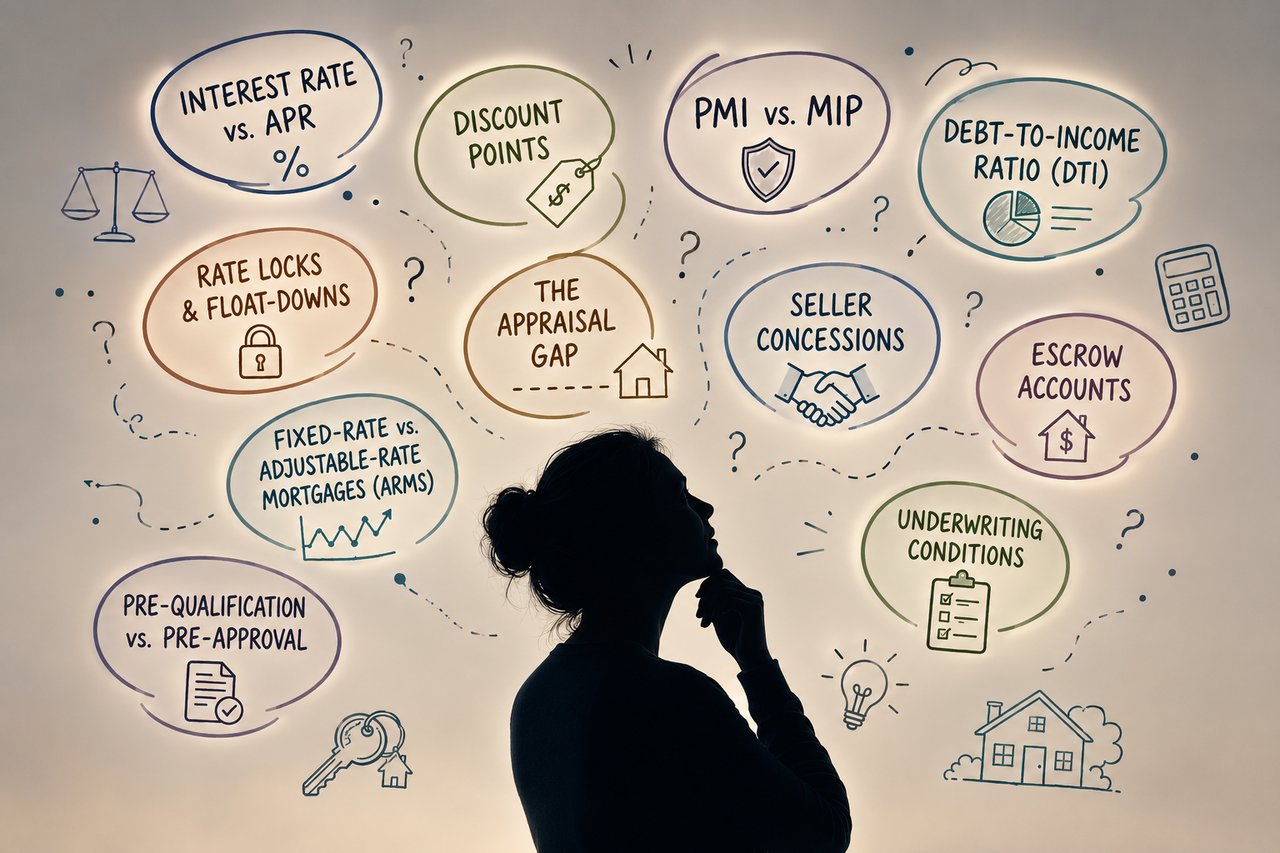
🏡 Home Financing, Decoded: The Terms That Trip Up Even Experienced Buyers
If you've started shopping for a mortgage, you've probably noticed that lenders love acronyms and buyers rarely get a plain-English explanation of what they actually mean. Understanding these concepts before you're sitting across from a loan officer can save you thousands of dollars and a lot of stress. Here's a breakdown of the financing terms that confuse buyers most — explained the way I wish someone had explained them to me.
📊 Interest Rate vs. APR: Why They're Not the Same Number
Your interest rate is what you pay on the loan balance itself. Your APR (Annual Percentage Rate) is a broader number that wraps in the interest rate plus certain lender fees, discount points, and other loan costs — expressed as a yearly percentage.
Here's why this matters: two lenders can quote you the same interest rate, but if one is charging more in fees, their APR will be higher. APR is designed to let you compare the true cost of loans apples-to-apples. When you're shopping lenders, don't just ask "what's your rate?" — ask for the APR too.
💰 Discount Points: Buying Down Your Rate
A "point" is a fee equal to 1% of your loan amount, paid upfront in exchange for a lower interest rate — typically around a 0.25% reduction per point, though this varies by lender.
The question every buyer should ask: how long until this pays for itself? If you pay $4,000 for a point that saves you $60/month, it takes about 5.5 years to break even. If you plan to move or refinance before then, buying points probably isn't worth it. If this is your forever home, it might be one of the smartest moves you make.
🛡️ PMI vs. MIP: The Insurance You Don't Want But Might Need
PMI (Private Mortgage Insurance) applies to conventional loans when your down payment is under 20%. It protects the lender, not you, in case you default.
MIP (Mortgage Insurance Premium) is the FHA loan equivalent, and it works a little differently — it often can't be removed without refinancing, unlike PMI, which typically falls off once you hit 20-22% equity.
The takeaway: putting down less than 20% isn't a dealbreaker, but you should understand exactly how much PMI will add to your monthly payment and how you'll eventually get rid of it.
📈 Debt-to-Income Ratio (DTI): The Number Lenders Care About Most
Your DTI compares your monthly debt payments (car loans, student loans, credit cards, and your future mortgage) to your gross monthly income. Most lenders want to see:
- ✅ Front-end DTI (housing costs alone) under 28%
- ✅ Back-end DTI (all debts combined) under 36-43%, depending on the loan program
This is often the single biggest factor in how much house you actually qualify for — sometimes more limiting than your credit score. Paying down a car loan or credit card before you apply can meaningfully increase your buying power.
🔒 Rate Locks and Float-Downs
Once you're under contract, your lender may let you "lock" your interest rate for a set period (commonly 30-60 days) so it doesn't change before closing. Rates can move daily, so this protects you from an increase between now and closing — but it also means if rates drop, you're stuck with the higher one, unless your lender offers a float-down option, which lets you capture a lower rate if one becomes available before closing (usually for an added fee).
Ask your lender directly whether float-down is included or optional — it's not always offered.
⚖️ Fixed-Rate vs. Adjustable-Rate Mortgages (ARMs)
A fixed-rate mortgage locks your interest rate for the life of the loan — predictable, but often starts higher than an ARM.
An ARM (like a 5/1 or 7/1 ARM) offers a lower fixed rate for an initial period (5 or 7 years), then adjusts periodically based on market rates. ARMs can make sense if you know you'll sell or refinance before the adjustment period kicks in, but they carry real risk if rates rise and you're still in the home when it adjusts. Always ask about the rate caps — the maximum the rate can increase per adjustment and over the life of the loan.
📉 The Appraisal Gap
In competitive markets, buyers sometimes offer more than a home's likely appraised value. If the appraisal comes in lower than the purchase price, the lender will only finance based on the appraised value — not your offer price. That gap has to be covered somehow.
An appraisal gap guarantee is a clause where you agree upfront to cover a certain amount of that gap in cash, which can make your offer more competitive without waiving the appraisal contingency entirely. This is a nuanced tool — it's worth discussing your specific numbers with your agent and lender before including it in an offer.
🤝 Seller Concessions
Sellers can sometimes contribute toward the buyer's closing costs — this is called a seller concession or seller credit. It doesn't reduce the purchase price; instead, it offsets what you owe at closing (things like loan origination fees, title insurance, or prepaid escrow items). Loan programs cap how much a seller can contribute, usually as a percentage of the purchase price, and the cap varies by loan type and down payment size.
🏦 Escrow Accounts: Where Your Taxes and Insurance Actually Go
Most lenders require an escrow account, where a portion of your monthly mortgage payment is set aside to cover property taxes and homeowners insurance. The lender pays these bills on your behalf when they're due.
Two things surprise buyers here:
- 1️⃣ Your first payment often includes extra "cushion" months of escrow deposits collected upfront at closing.
- 2️⃣ Your monthly payment can change year to year — not because your rate changed, but because your tax bill or insurance premium did. This is normal and shows up as an "escrow analysis" adjustment.
🔍 Underwriting Conditions
Getting pre-approved isn't the finish line — your loan still has to go through underwriting, where an underwriter verifies everything: income, assets, employment, the appraisal, and title. It's common to get "conditional approval" with a list of additional documents requested before "clear to close."
⚠️ The biggest mistake buyers make during this window: taking on new debt, changing jobs, or making large, undocumented deposits into their bank account. Any of these can delay or derail your closing. Once you're under contract, keep your financial life as boring and unchanged as possible until you have keys in hand.
✍️ Pre-Qualification vs. Pre-Approval
These sound interchangeable but aren't:
- 🔹 Pre-qualification is a quick, informal estimate based on information you self-report — no verification involved.
- 🔹 Pre-approval involves the lender actually verifying your income, assets, and credit, and results in a conditional commitment for a specific loan amount.
In competitive markets, a pre-qualification letter won't carry much weight with a seller. A true pre-approval — ideally underwritten in advance — puts you in a much stronger position when it's time to make an offer.
📲 Want more tips and local market updates? Follow me on Instagram: @bridgetconroy