From Chocolate to Condos: The Remarkable Story of the Walter Baker Factory in Lower Mills
If you've ever driven along Adams Street where it crosses the Neponset River, you've passed one of the most historically significant industrial sites in American history. The red brick buildings that now make up Baker Square Condominiums weren't always home to loft-style residences and riverside terraces. For two centuries, they were the beating heart of the country's first chocolate factory — and the source of a sweet aroma that locals say you could smell for miles.
A Chance Meeting on the Banks of the Neponset
The story begins in 1765, when a Harvard-educated doctor named James Baker met John Hannon, a penniless Irish immigrant who happened to be a skilled chocolatier — a craft that, at the time, existed almost exclusively in Europe. Baker saw an opportunity. He provided the financial backing; Hannon provided the expertise. Together, they converted a sawmill on the banks of the Neponset River into America's first chocolate mill.
The process was straightforward but labor-intensive: cocoa beans were ground between two massive millstones powered by the river's current, producing a thick syrup that was poured into molds to form chocolate "cakes." Sold under the name Hannon's Best Chocolate, each cake came with a remarkable guarantee printed on the wrapper: "If the Chocolate does not prove good, the Money will be returned."
The venture thrived. By 1768, the partners had outgrown their original mill and moved to a larger facility. Then, in 1779, Hannon disappeared during a voyage to the West Indies and never returned. His widow sold her share to Dr. Baker, who consolidated the two operations and in 1780 sold the first bars under the official name Baker's Chocolate.
Building a Chocolate Empire
The company passed through generations of the Baker family — from James to his son Edmund, and then to Edmund's son Walter, who officially renamed it Walter Baker & Company in the 1820s and introduced the first sweetened chocolate bars in 1849. Those bars were an instant hit.
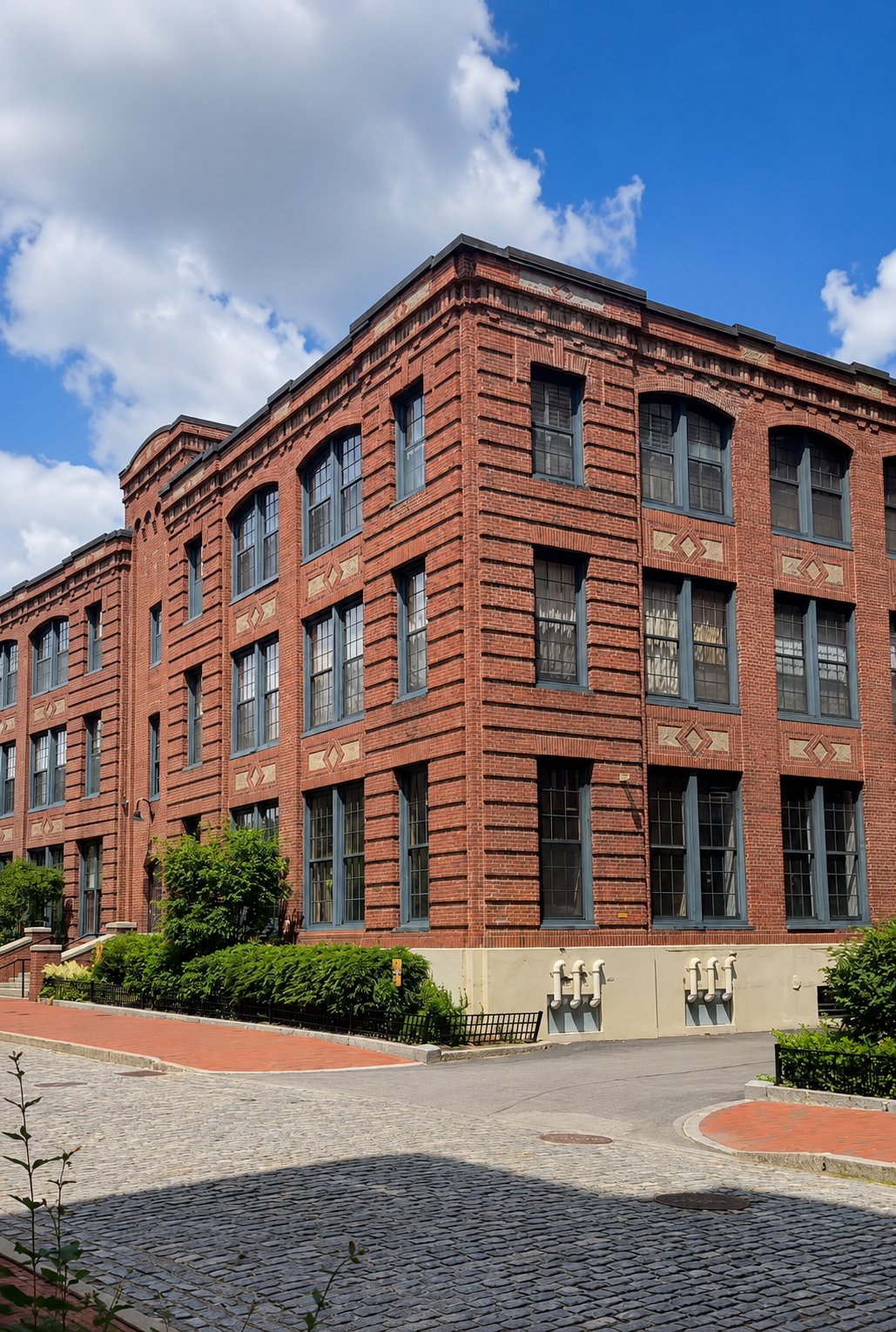
The most transformative chapter came under Henry Lillie Pierce, a stepnephew of Walter Baker, who took control of the company in the 1850s. Pierce bought out every local competitor along the Neponset — the Preston Mill, the Ware Mill, and the Webb Mill — and aggressively expanded the factory complex with the grand red brick buildings that still stand today, many designed by prominent Boston architect Nathaniel J. Bradlee.
Pierce was also a marketing visionary. He brought Baker's chocolate to world's fairs across the globe, winning a Silver Medal at the 1867 Paris Exposition and top honors in Vienna and Philadelphia. He introduced "La Belle Chocolatière" — the iconic image of a porcelain-cheeked chocolate girl — as the company's trademark in 1877, a logo that remained synonymous with Baker's chocolate for generations. At its peak under Pierce, the factory was producing five tons of chocolate per day.
One remarkable footnote: after visiting Baker's display at the 1893 Chicago World's Fair, a Lancaster, Pennsylvania candy maker named Milton Hershey hired two Baker Chocolate employees and used what he learned to launch Hershey's Chocolate the following year.
The End of an Era
The Baker family sold the company to the Forbes Syndicate in 1896 for $4.75 million. The Postum Cereal Company purchased it in 1927 — becoming General Foods two years later — and continued operating the Lower Mills plant for nearly four more decades. In 1965, exactly two centuries after that first batch of cocoa beans was ground on the Neponset, General Foods shut down the factory and moved production to Dover, Delaware. The chocolate era in Lower Mills was over.
The brand was eventually acquired by Kraft Foods in 1995 and is now part of Kraft Heinz — still sold in grocery stores today under the Baker's Chocolate name.
Baker Square Condominiums: Historic Character, Modern Living
Today, the landmark red brick mill buildings along Adams Street have been thoughtfully converted into Baker Square Condominiums, a 175-unit residential community that sits directly on the Neponset River at the Milton-Dorchester line. The complex is listed on the National Register of Historic Places as part of the Dorchester/Milton Lower Mills Industrial District.
The five historic mill buildings — Forbes Mill, Park Mill, Baker Mill, Water Mill, and the Carriage House — each contribute their own architectural personality to the community. Units are celebrated for their original industrial character: exposed red brick walls, soaring ceilings up to 30 feet, massive factory windows, and open-concept loft layouts. Many have been updated with premium finishes including gourmet kitchens, wide-plank hardwood floors, and luxurious bathrooms, while preserving the authentic charm of exposed beams and original brick.
Floor plans range from one-bedroom units starting around 729 square feet to expansive multi-level penthouses exceeding 2,100 square feet, with many featuring bi-level layouts and dens. The views — over the Neponset River, the Baker Dam, and the village of Milton — are among the most distinctive in the area.
Community amenities include:
- Indoor heated lap pool, hot tub, and sauna
- Fully equipped fitness center, open 4am–midnight
- Waterfront terrace with gas grills and lounge seating overlooking the river
- Direct access to the Neponset River Greenway walking and cycling trail
- Deeded garage and surface parking for every unit
- Steps from the Milton stop on the MBTA Red Line Mattapan Trolley
- Pet playground and bike storage
The location puts residents in the heart of the vibrant Lower Mills neighborhood — with Steel & Rye, Madre Osteria, and a growing roster of restaurants and cafes within easy walking distance — while maintaining quick access to Milton Village, the South Shore, and downtown Boston via the Red Line.